

-
Contact number:
+86 752 3339581 / 3339952 +86 755 84660522 / 84682177


time:2026-07-31 source: Views:0
Let’s be honest: the solar street lighting market is booming. The numbers are everywhere. One report says it hit $12 billion in 2025 and is climbing
toward $25.5 billion by 2030 at a 16.2% CAGR. Another pegs it at $18.4 billion in 2026, heading toward $52.7 billion by 2033. Pick your favorite
analyst – they all agree on one thing: this market is on fire.
But here’s what the glossy reports don’t tell you. The industry is also getting complicated. And that’s where the real story is.
The Regulatory Maze Is Real
If you’re an OEM or ODM partner sourcing solar lighting, 2026 is the year you can’t afford to ignore compliance. The EU’s Energy Performance
of Buildings Directive (EPBD) requires member states to transpose solar-on-buildings rules by May 29, 2026, with the first building-level deadline
hitting December 31, 2026. Meanwhile, the EU ErP directive now mandates a minimum initial light efficiency of 100lm/W for outdoor solar lighting,
with standby power consumption below 0.5W. In North America, DLC certification requires at least 120lm/W. And if you’re selling into municipal
projects, ANSI C136.40 and UL 8750 are now table stakes.
What does this mean for buyers? Simple: “good enough” isn’t good enough anymore. If your supplier can’t meet these standards, your shipment isn’t clearing customs. Period.
The Tech Bar Is Rising, Too
Beyond regulations, the technology itself is evolving fast. Solar street lighting is moving from a niche off-grid solution to a core component of
low-carbon public infrastructure. AI-enabled controllers are analyzing battery state of charge, pedestrian activity, and weather forecasts to optimize
performance. IoT integration and predictive maintenance are becoming standard expectations. All-in-one and split-system configurations with
lithium-based batteries, sensors, and remote monitoring are replacing traditional pole-mounted designs.
So Where Does That Leave OEM Buyers?
Here’s the thing. Most suppliers can slap together a solar light. But can they navigate the regulatory labyrinth? Can they integrate AI controls?
Can they customize battery chemistry for different climate zones?
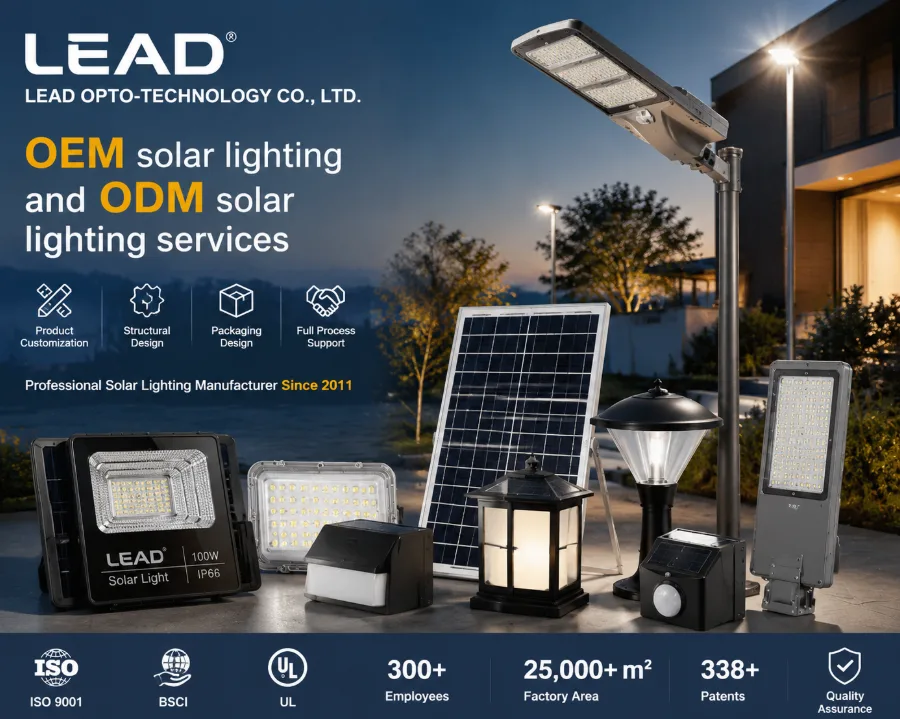
That’s where LEAD OPTO-TECHNOLOGY CO., LTD. comes in. With a 25,000-square-meter self-owned factory in Shenzhen and Huizhou,
over 300 employees, and 338 patents (92 of them international), they’re not a trading company playing dress-up. They’re a vertically integrated
manufacturer that designs molds, builds battery packs, programs ICs, and manufactures solar panels—all in-house. Power ranges from 1.5W to 120W,
covering garden lights, street lights, flood lights, bollards, and more.
And here’s the kicker: they hold ISO 9001, ISO 14001, BSCI, and UL certifications. Products comply with TÜV, CE, RoHS, and REACH.
They’ve been doing this since 2011—long enough to have seen the fads come and go, and long enough to actually understand the regulatory shifts
that are catching others off guard.
The Bottom Line
The solar street lighting market is growing fast. But growth without competence is just chaos. If you’re sourcing OEM or ODM solar lighting in 2026,
you need a partner who’s already ahead of the compliance curve—not one who’s still Googling what ErP stands for.
LEAD OPTO isn’t flashy. They don’t need to be. They’ve got a factory, a patent portfolio, and a track record with Fortune 500 companies.
In an industry where “OEM” is thrown around like confetti, that actually means something.

Whatsapp/Wechat: +86 15019255365

Whatsapp/Wechat: +86 15019255365
+86 752 3339581 / 3339952 +86 755 84660522 / 84682177
lead@lead-lighting.com


 EN
EN Home >